
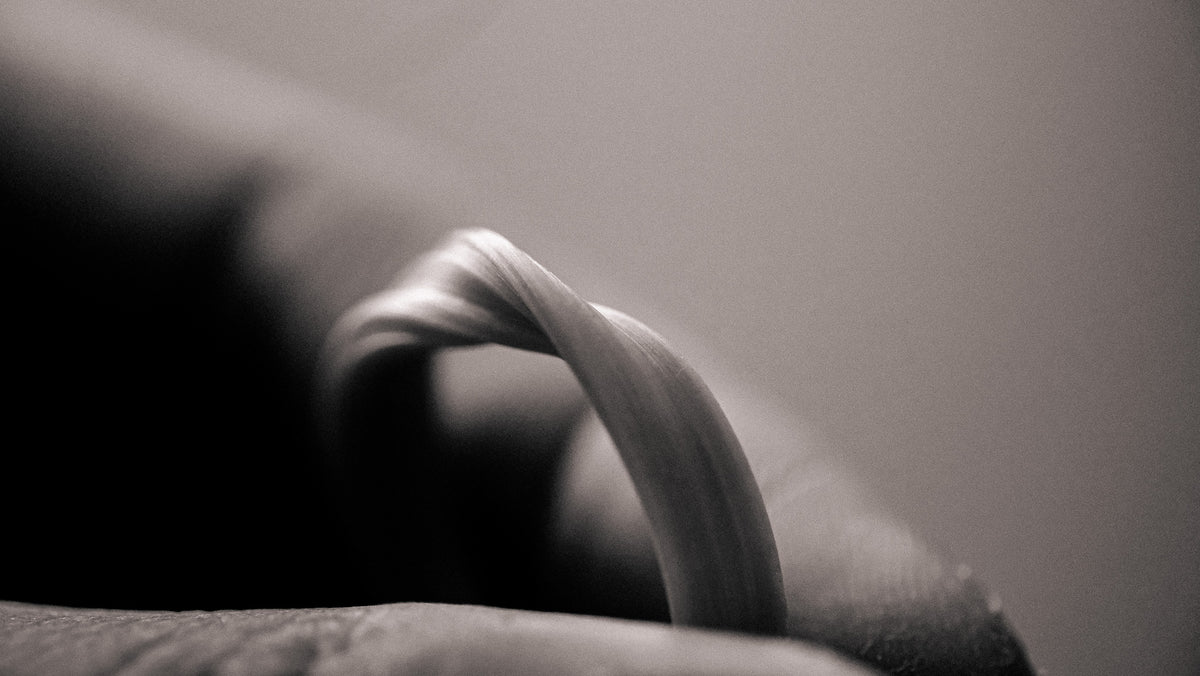
What is Mitsuro hikime?
Mitsuro hikime is a Japanese wax technique in which a soft blend of beeswax and pine resin is warmed and worked by hand, then pulled and folded until its surface striates. The form is cast in metal, and that texture stays in the finished piece.
The name
Mitsuro is the wax: mitsu, honey; ro, wax. Hikime describes what is done to it — hiki, to draw or pull, and me, the grain that results. Pulled-wax grain, roughly.
The material
Most jewelry wax is hard. It's carved with blades and burs the way you'd work wood, and it holds whatever shape you cut into it. Mitsuro behaves nothing like that. It's soft, slightly tacky, and at room temperature too stiff to move at all.
It takes about ten minutes of warming and working before it gives. Until then, nothing happens, which means the piece begins as a record of how long it was worked and how it was moved.
Pulling

Once softened, the wax is drawn out, folded back into itself, and drawn again. Each fold traps a little air and a little of the previous surface, and after enough repetitions fine parallel lines appear along the direction of the pull — the striations. They are not cut; they are what the material does when it is stretched.
Stop pulling and the wax sets. Keep going and the lines multiply and cross.
What it does that carving can't
Because Mitsuro is sculpted rather than cut, it holds organic undercuts, twists, and closed loops that are difficult to reach with a blade.
The surface texture comes from the material rather than a tool. It isn't drawn or specified; it's what the wax did.
Is Mitsuro hikime the same as lost wax casting?
No, they're two stages of one process. Mitsuro hikime is how the model is made. Lost wax casting is how that model becomes metal. A Mitsuro form is cast by the lost wax method, like most fine jewelry; what differs is the wax itself and the way it's worked.
Where Mitsuro hikime comes from
Mitsuro is an old material in Japanese metalwork. The wax was used in casting long before it was used for jewelry.
How I came to it

Before this I worked in finance, then in technology, in the US. What I collected in those years wasn't jewelry — it was ceramics. Handmade pieces, gathered over travels to Japan, Portugal and Denmark.
What I liked were the throwing lines, the places where you can see the clay was moving and someone's hand was on it. A machine-made bowl and a thrown one can look alike until you pick them up.
After moving to Japan, I took a trial class at Tomoyasu, a Mitsuro studio in Tokyo that has been doing this for nearly fifty years. I expected to carve something. Instead I was handed a lump of wax and told to knead it.
I left that day with sore palms. You can have a plan for what to make, but the ending is a surprise.
That was when I understood that jewelry could carry what I had found in the ceramics: the trace of a hand.
A year later I set up a bench in Karuizawa. I've trained since with artisans in Japan and in Europe, and I set stones with Western techniques — pavé, bright-cut bezels — on forms made the Japanese way.
I still work in Mitsuro because of that first class. The wax records how long you held it and how you moved it. Clay does the same thing. Almost nothing else I've worked with does.
In gold

Cast in K18, the striations survive. Light travels across the surface unevenly rather than sliding off a polished face.
No two pulls are ever identical, which is why a form can't be made twice by hand. So a mold is taken from the master and every piece is cast from it — the pulling happened once, and each piece carries it. The Permanent Collection is made this way.
One Of A Kind pieces are sculpted once and never molded.